Why responsible travel matters in Western Australia
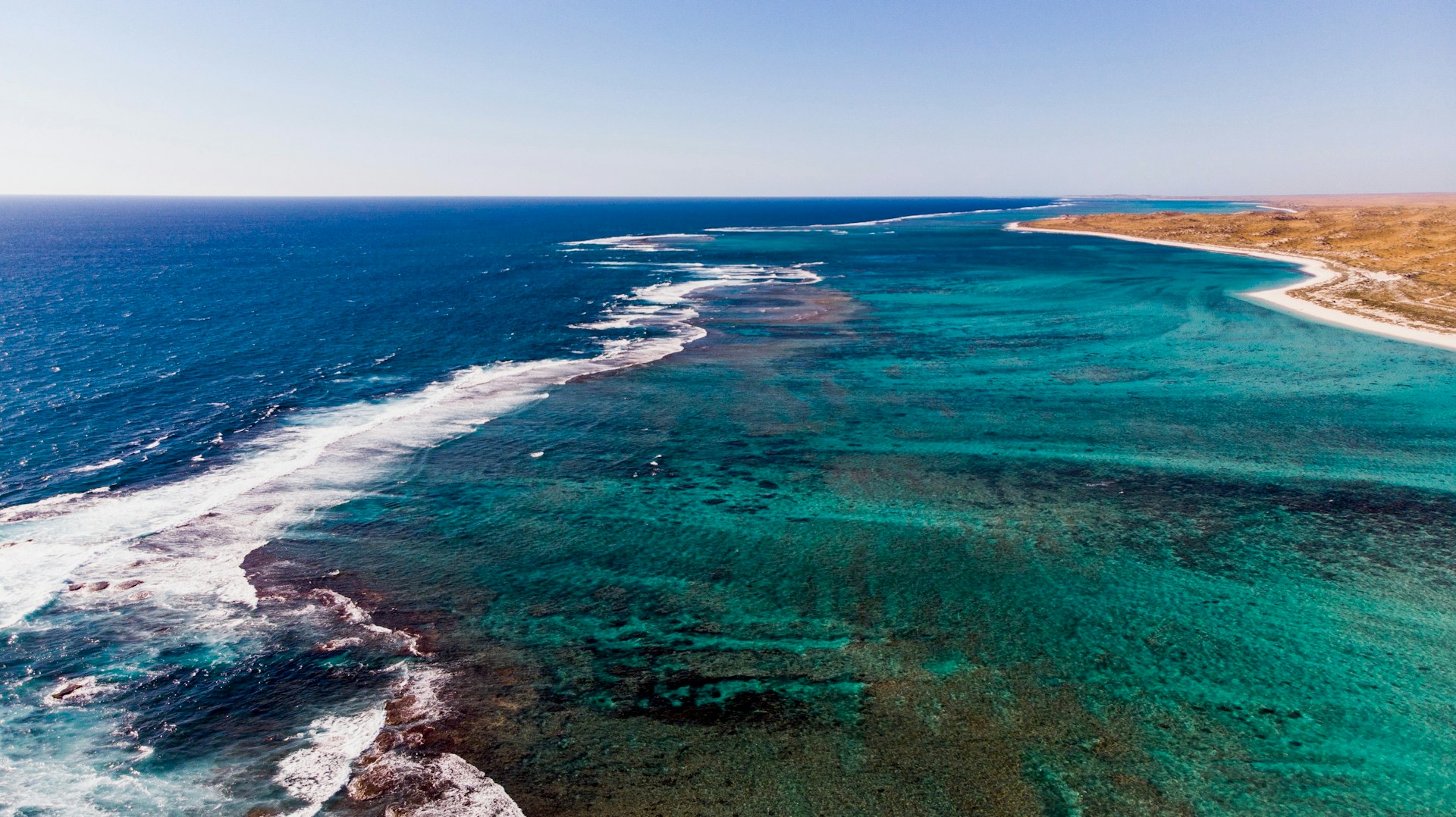
Western Australia contains two UNESCO World Heritage Areas that are, by any scientific measure, among the most ecologically significant marine environments on Earth. Both are in documented decline. The Ningaloo Coast — Australia's largest fringing reef, stretching 260km along the state's northwest coast — has just experienced the most catastrophic bleaching event in its recorded history. Shark Bay, 700km to the south, is still recovering from a seagrass collapse that destroyed the food base for one of the world's largest dugong populations. The Kimberley, spanning 423,000 square kilometres of the state's north, looks pristine from the air but carries the cumulative pressure of altered fire regimes, invasive species, and decades of overgrazing.
The 2025 bleaching season at Ningaloo was unprecedented. Sea surface temperatures built from August 2024 into the worst underwater marine heatwave ever recorded in Australia — peaking at 4°C above the summer average, with degree heating weeks of up to 16 (the threshold for widespread coral mortality is 8). In March 2025, researchers from Curtin University recorded bleaching on up to 90% of corals in shallow lagoon areas. By October 2025, of more than 1,600 corals counted, only around 600 had survived — a mortality rate exceeding 60% at northern and central lagoon sites, with an estimated 70% of Ningaloo's corals dying in a single season. Corals that had been growing for hundreds of years — massive Porites colonies, normally the most resilient — were among those lost. It was also the first time Ningaloo and the Great Barrier Reef bleached simultaneously, as part of the fourth global coral bleaching event.
Shark Bay's pressures came a decade earlier. During the "Ningaloo Niña" heatwave of 2010–11, sea temperatures reached 5°C above normal for two weeks, destroying approximately 900km² of seagrass — the foundation of the ecosystem. Dugong densities fell by 67% in the years that followed. Both the seagrass meadows and the dugong population have partially recovered, but repeated heatwaves make full recovery increasingly uncertain.
What responsible tourism looks like here
Western Australia has more structured wildlife interaction regulations than almost anywhere else in Australia. The Department of Biodiversity, Conservation and Attractions (DBCA) licenses all commercial wildlife swim tours under the Conservation and Land Management Act 1984 (CALM Act), with specific rules governing each species.
For whale shark swims — the defining experience at Ningaloo — only 11 licensed operators are permitted to run tours, out of a maximum of 15 licences available. Every licensed operator uses a spotter plane to locate sharks (typically operating from ~9:30am across a 6×50km search area). In the water, regulations require: a minimum 3 metres from the shark's body at all times, 4 metres from the tail, no positioning ahead of the shark, no touching, no flash photography, maximum 10 swimmers plus 2 crew per entry, and a 60-minute limit per swimmer group. These rules are not guidelines — they are licence conditions enforced by guides trained in DBCA protocols.
For humpback whale swims, a separately managed programme (DBCA's Management Program for Humpback Whale Interactions, 2020) issues licences to run swim tours within Ningaloo Marine Park state waters. Outside a licensed tour, it is illegal to swim within 100 metres of any whale. The programme prioritises minimising impacts on mothers with calves, whose nursery habitat in Exmouth Gulf was afforded additional protection in September 2025 when the WA Government formally established the Exmouth Gulf Marine Park — covering the entire Gulf with 30% sanctuary zones, jointly managed and jointly vested with the Nyinggulu Traditional Owners (Nganhurra Thanardi Garrbu Aboriginal Corporation).
Among commercial operators, the most credible certification signals are Ecotourism Australia's ECO Certification and the Advanced Ecotourism designation. Several Ningaloo operators — including Sail Ningaloo, Live Ningaloo, and Ningaloo Coral Bay Boats — have held advanced accreditation for over a decade; Kimberley Quest has been ECO Certified for more than 20 years and was inducted into Ecotourism Australia's Hall of Fame in 2023.
For the Kimberley and Shark Bay, the most meaningful responsible tourism choice is booking with Aboriginal-led operators. The Western Australian Indigenous Tourism Operators Council (WAITOC) represents close to 200 Aboriginal tourism businesses across the state and maintains a searchable directory. In the Shark Bay / Gutharraguda region, Wula Gura Nyinda Eco Cultural Adventures, run by Malgana man Darren "Capes" Capewell, offers kayak, 4WD, and multi-day walking tours on Dirk Hartog Island. The philosophy is explicit: the tours exist to fund the work of looking after Country, not the other way around.
Do's and don'ts
Do:
- Book whale shark tours only with a DBCA-licensed operator — verify current licence status before booking, as licences are annually renewed
- Look for Ecotourism Australia ECO Certified operators at Ningaloo; several hold Advanced Ecotourism status, the highest certification tier
- Book with WAITOC-member Aboriginal operators in the Kimberley and Shark Bay regions — their directory at
waitoc.comis the most reliable starting point - Download the Explore Parks WA app (DBCA) before visiting any national park — it provides current conditions, closures, and permit requirements
- At Monkey Mia (Shark Bay), watch the dolphin feeding only during the official ranger-led sessions — unsupervised interaction is prohibited
Don't:
- Touch whale sharks, manta rays, or humpback whales, or position yourself ahead of a whale shark — these are licence conditions, not suggestions
- Swim within 100 metres of any humpback whale outside a DBCA-licensed tour
- Touch or walk on the stromatolites at Hamelin Pool, Shark Bay — they grow at approximately 1mm per year and may be thousands of years old
- Collect coral, shells, or any marine organisms from Ningaloo Marine Park or any WA marine park — it is illegal throughout
- Anchor vessels on reef — use designated mooring buoys where available
Local organisations to know
DBCA — Department of Biodiversity, Conservation and Attractions manages all of WA's national parks, marine parks, and World Heritage Areas. It licenses all commercial wildlife interaction operators, enforces CALM Act conditions, and publishes management plans for Ningaloo, Shark Bay, and the Kimberley Wilderness Parks. The DBCA website is the authoritative source for current rules, permits, and access conditions.
WAITOC — Western Australian Indigenous Tourism Operators Council is the peak representative body for Aboriginal tourism in WA, with close to 200 members. Its online directory is the most reliable way to find Aboriginal-led operators across the state — from Broome and the Kimberley to Shark Bay and the Southwest.
ATWA — Aboriginal Tourism Western Australia is WAITOC's charitable subsidiary, focused on building operator capacity through mentoring and funding. Supporting operators connected to ATWA directly contributes to the financial sustainability of Aboriginal-led tourism businesses.
Protect Ningaloo is a campaign hosted by the Australian Marine Conservation Society (AMCS), with author Tim Winton as patron. It monitors and opposes industrial threats to the Ningaloo Coast World Heritage Area — including past proposals to dump decommissioned offshore infrastructure in reef-adjacent waters.
Shark Bay World Heritage Discovery and Visitor Centre in Denham is the first stop for responsible exploration of Shark Bay — with interpretive exhibits on the seagrass ecosystem, dugong ecology, and the cultural significance of Gutharraguda to the Malgana people.
Government and policy context
Western Australia is one of the few places on Earth with two separate UNESCO World Heritage Areas in close proximity, both inscribed for natural values. Shark Bay (inscribed 1991) covers 2.2 million hectares and is listed under all four natural Outstanding Universal Value criteria — one of fewer than 40 sites globally to achieve this. Its 3,700km² of seagrass meadows are among the world's largest and most diverse. Ningaloo Coast (inscribed 2011) covers 604,500 hectares of marine and terrestrial property, encompassing Ningaloo Marine Park, Cape Range National Park, and the Muiron Islands Marine Management Area. Its 260km reef runs directly adjacent to shore — within swimming distance along much of its length — making it uniquely accessible and uniquely vulnerable.
The CALM Act 1984 is the primary legislative framework governing how operators access and interact with wildlife in WA's parks and marine areas. All commercial tours require DBCA licensing with attached conditions; breaching those conditions can result in licence revocation. The whale shark management programme has been operating in its current form since 1993, and is regarded internationally as a model for managing large-scale wildlife tourism.
The establishment of the Exmouth Gulf Marine Park in September 2025 was a significant step: it applies formal protection to a body of water adjacent to the Ningaloo Coast WHA that had previously been unprotected, covering critical humpback whale nursery habitat, dugong seagrass feeding grounds, and critically endangered sawfish. Its joint management and joint vesting with Nyinggulu Traditional Owners sets a precedent for how new marine protected areas in WA incorporate Indigenous governance.
The 2025 bleaching event has shifted the conservation conversation about Ningaloo from long-term risk to immediate crisis. Curtin University researchers have described it as the reef's most severe bleaching in recorded history. Whether Ningaloo can recover before the next major thermal event depends entirely on how quickly global emissions fall — and whether the visitors, operators, and governments responsible for its management treat it accordingly.