Why responsible travel matters in Jordan
The Dead Sea is disappearing. Over the past 50 years, the water level has dropped by 45 metres and the surface area has shrunk from approximately 1,050 km² to around 605 km² — a 42% loss. The water level continues to fall at approximately one metre per year. Thousands of sinkholes have opened along the Jordanian shore as the underground salt layers that kept the ground stable dissolve in freshwater infiltrating the newly exposed land. The resorts built along the northern Jordanian coastline now stand on a landscape actively collapsing beneath them.
The cause is well documented. Roughly 90% of the Jordan River's natural flow has been diverted upstream for agriculture and municipal use across Jordan, Syria, Lebanon, and Israel — over 50 dams have been built on Jordan River tributaries in the past half century. Industrial evaporation ponds operated by mining companies account for an estimated 25–40% of additional water extraction. What remains reaching the Dead Sea is a fraction of the flow that sustained the lake for millennia.
Jordan is ranked the second most water-scarce country in the world by UNICEF, with only 88 cubic metres of renewable freshwater per person per year — far below the 500 m³ threshold for severe scarcity, and a fraction of the 1,700 m³ global average. The country hosts over 660,000 registered Syrian refugees. Tourism, with its high per-guest water footprint through hotel infrastructure, swimming pools, and resort operations, is a live tension in this context.
Petra, Jordan's most-visited site and one of the world's most iconic archaeological landscapes, reached 1.1 million visitors in 2019 — and the rose-red sandstone it is carved from is actively degrading under the combined pressure of foot traffic, surface runoff, and flash floods. In 2023, Petra became the first city in the Arab world to join the Global Sustainable Tourism Council, and PDTRA — the Petra Development and Tourism Region Authority — commissioned a formal carrying capacity study. The results of that study had not yet been published as of early 2026.
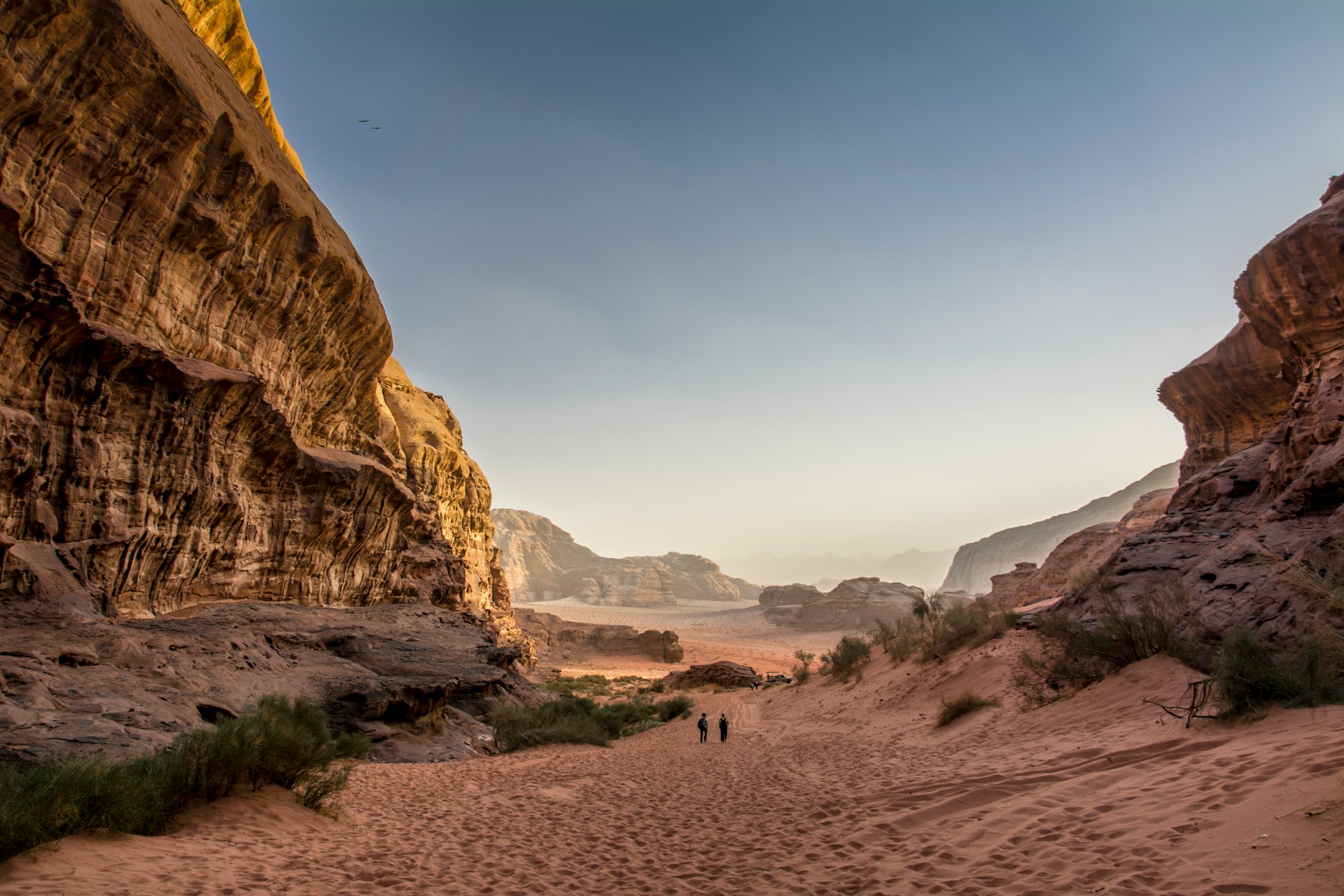
Wadi Rum, a 74,200-hectare UNESCO dual World Heritage site for its geological formations and 12,000 years of human inscription, faces a different but related pressure: an estimated 1,200 four-wheel-drive vehicles operating within the core area. UNESCO's State of Conservation reports identify uncontrolled vehicle traffic as the single greatest threat to the site's ecological integrity and to the 25,000 rock carvings and 20,000 inscriptions that mark its sandstone surfaces. Twenty-eight of the 65 tourist camps operating inside the protected area were found to be unlicensed; Jordanian authorities mandated compliance or closure by September 2022.
What responsible tourism looks like here
Jordan's most important responsible tourism institution is the Royal Society for the Conservation of Nature (RSCN), established in 1966 under royal patronage with a public-service mandate to manage and protect Jordan's natural heritage. The RSCN manages 11 nature reserves covering roughly 1% of Jordan's land area and operates Wild Jordan — a social enterprise that runs ecotourism products across reserves, with all profits funding conservation. Wild Jordan won the Guardian/Observer Ethical Travel Award in 2010.
Dana Biosphere Reserve (292 km²), Jordan's largest reserve, has received four international sustainable development awards and draws over 30,000 visitors annually. The RSCN-managed Dana Guesthouse and Rummana Campsite provide accommodation where fees go directly to conservation and local employment. Within Dana sits the Feynan Ecolodge — solar-powered, designed to be dark at night by design, and operated by EcoHotels, a local Jordanian company, since 2009. The lodge employs approximately 80 Bedouin families, employs 45 local drivers on a rota where 100% of transfer fees go to drivers, and runs leatherwork and candle-making workshops for rural women in surrounding communities. It is one of the most completely community-integrated accommodation models in the Middle East.
Mujib Biosphere Reserve, a UNESCO Biosphere since 2011, offers canyoning through Wadi Mujib. Azraq Wetland Reserve — once drained entirely by mid-1990s overpumping before restoration began — now has visitor boardwalks and bird hides operated by Wild Jordan. Ajloun Forest Reserve in the north offers Mediterranean oak forest trails. These reserves are connected through Wild Jordan's booking system, and fees across all of them feed back into the RSCN's conservation budget.
The Jordan Trail — a 675+ km hiking route from Um Qais in the north to Aqaba on the Red Sea, designed as a 40-day thru-hike — was built explicitly as a community tourism mechanism. Hikers stay in local guesthouses, eat with families, and hire local guides across 75 villages and towns. All service fees go directly to the communities hosting each section. This is not a passive amenity — it is a deliberate economic structure for rural communities whose livelihoods are otherwise limited.
In Aqaba, the Green Fins programme — led by the Aqaba Special Economic Zone Authority and the Reef-World Foundation — has achieved measurable results: 51% reduction in reef threats, 69% reduction in diver contact with coral, and 100% elimination of anchoring damage among certified operators in its first two years. Eleven dive operators hold Green Fins certification as of mid-2025.
Do's and don'ts
Do:
- Book Wadi Rum tours only with operators licensed by the Wadi Rum Protected Area Authority; ask for the licence before booking — unlicensed operators often camp outside the UNESCO boundary and do not share income with Rum village communities
- Walk the Siq at Petra; horse-drawn carriages in the Siq have been replaced by e-buggies since November 2021, which are faster, carry five passengers, and still return 75% of fares to horse-owner families — use the e-buggy
- Book accommodation within RSCN reserves — Dana, Feynan, Mujib, Azraq — rather than external lodges; fees fund conservation directly and employment goes to Bedouin communities
- Hire local guides through the Jordan Trail Association, particularly in remote sections through Wadi Rum, Dana, and Ajloun; many sections have no water or connectivity and require guide knowledge, and all guide fees go to communities
- Minimise water use throughout Jordan; 88 m³ per person per year means every litre of tourist water use is a meaningful fraction of a scarce resource — short showers, towel reuse, and avoiding unnecessary water consumption are not small gestures here
- Ask before photographing people, particularly Bedouin women in Wadi Rum and rural communities; photographing women without explicit permission is a serious cultural violation, not a minor sensitivity
Don't:
- Apply sunscreen, mud, or cosmetics before floating in the Dead Sea; the minerals in the water react with synthetic chemicals, and the Dead Sea has lost 42% of its surface area and cannot absorb additional pollution loads — rinse off at the freshwater showers before entering, and limit immersion to 15–20 minutes
- Book Wadi Rum 4x4 tours with operators who drive off marked tracks; the 25,000 rock carvings and the desert ecosystem are directly damaged by off-track vehicles, and UNESCO flags this as the site's primary threat — ask explicitly whether your operator stays on defined routes
- Remove any artefacts, rock fragments, or sand from protected areas; removing items from Petra, Wadi Rum, or RSCN reserves is illegal and contributes directly to site degradation
- Accept hospitality from Bedouin hosts and offer payment in return; offering money for tea, coffee, or a shared meal is deeply offensive; if invited for a meal, a small household gift is appropriate; support communities by paying for guided experiences and buying from community cooperatives
- Choose Dead Sea resort hotels without research; large-scale resort development continues along the northern Jordanian shoreline despite documented sinkhole and subsidence risk and active environmental controversy — consider visiting on a day trip from Amman rather than staying in the resort strip
- Enter restricted zones, climb façades, or venture beyond marked trails at Petra; the sandstone is actively degrading and the Petra Development and Tourism Region Authority enforces defined routes — climbing on carved surfaces causes irreversible damage
Local organisations to know
Royal Society for the Conservation of Nature (RSCN) holds a public-service mandate for conservation in Jordan — one of the very few NGOs in the Arab world with this status. Managing 11 reserves and operating Wild Jordan as its social enterprise arm, the RSCN is the single most important institution for responsible tourism in the country. Wild Jordan's online booking system covers all reserve accommodation, guided experiences, and the Amman café whose profits fund reserve operations.
Jordan Trail Association (JTA) manages the 675 km national long-distance trail and its network of community guesthouses, local guides, and homestays across 75 Jordanian towns and villages. Their website includes section maps, accommodation listings, and guide contacts — all linked directly to community income.
FOUR PAWS International led the Petra horse welfare programme from 2014 until April 2025, replacing horse-drawn carriages in the Siq with electric e-buggies in partnership with PDTRA and the Princess Alia Foundation. FOUR PAWS handed the programme over to Jordanian authorities in April 2025 after building local veterinary and welfare capacity. Approximately 1,350 horses, donkeys, and mules continue to work at Petra for riding; welfare monitoring is now the responsibility of PDTRA.
Brooke pioneered working animal welfare work in Petra from 1988 through the Princess Alia Veterinary Clinic, concluding its programmes in 2015. Their documentation of the Petra animal welfare history remains a useful reference.
Green Fins Jordan is the sustainable diving and snorkelling certification programme operating in Aqaba, run by the Aqaba Special Economic Zone Authority and the Reef-World Foundation. Eleven operators are certified; if you are diving or snorkelling in Aqaba, book with a Green Fins member.
Government and policy context
Tourism is managed by the Ministry of Tourism and Antiquities (MoTA) and the Jordan Tourism Board (JTB). The National Tourism Strategy 2021–2025 targets inclusive economic growth through sustainable tourism, and the sector has substantially exceeded its recovery targets: 6.35 million tourists arrived in 2023, generating JD 5.25 billion — above 2019's pre-pandemic peak figures. Tourism accounts for approximately 14.6% of GDP and employs around 58,000 people directly.
The Wadi Rum Protected Area Authority regulates activities within the UNESCO property. Its 2021 regulations prohibit off-track driving, camping outside designated areas, hunting, habitat modification, mining, and pollution. The September 2022 enforcement deadline required all tourist camps within the protected area to be licensed and operating under signed lease agreements, with non-compliant camps to be dismantled. UNESCO's 2023 State of Conservation report continued to flag uncontrolled tourism as the property's primary threat — full enforcement is ongoing.
In Aqaba, the Aqaba Special Economic Zone Authority (ASEZA) governs sustainable tourism development and is working toward a Green Destinations Bronze Award by 2025/2026 — a formal destination-level sustainability certification.
Petra's GSTC assessment in 2023 — the first such formal assessment in the Arab world — marked a significant policy shift: PDTRA is now formally committed to a carrying capacity study and destination-wide sustainability framework. The study had not been published as of early 2026, but the commissioning itself signals that Petra's management is beginning to engage seriously with visitor density as a policy variable rather than simply a logistical one.
The Dead Sea's long-term decline has no resolution in sight. A Red Sea–Dead Sea canal to replenish the lake through desalination and conveyance was studied by the World Bank in 2013–2015 and has since stalled. No active alternative mechanism to reverse the water level decline exists. The Dead Sea is shrinking on a fixed trajectory; the timescale is measured in decades, not centuries.