Why responsible travel matters in Bali
Bali received 16.4 million visitors in 2024 — 10.1 million domestic and 6.3 million international — in an island of 5,780 km² and approximately 4.3 million residents. Tourism accounts for roughly 22% of Bali's GDP and saturates a narrow coastal and highland strip that draws the overwhelming majority of visitor spending. The economic returns are real. So are the costs, which fall unevenly on the Balinese communities, ecosystems, and cultural infrastructure that make the island worth visiting.
The most acute crisis is water. Over 65% of Bali's fresh water is now directed toward the tourism sector, competing directly with the agricultural demands of the Subak irrigation system — the 9th-century communal water management network that created the rice terraces and is the foundation of Balinese Hindu cultural life. The average international tourist uses approximately three times the water per day that a local resident does. Star-rated hotels require around 800 litres per room per night from an already over-extracted aquifer. Groundwater levels have dropped by more than 50 metres in some parts of southern Bali within less than a decade. Community wells have dried up. What is being consumed by tourism infrastructure is a shared commons that cannot easily be replenished.
The plastic situation is similarly measurable. Bali generates approximately 3,400 tonnes of waste per day, with around 89 tonnes of plastic estimated to enter the ocean daily. Kuta and Legian beaches receive up to 60 tonnes of plastic annually through ocean currents — much of it transboundary, carried to Bali's shores from other Indonesian provinces during the monsoon season, though the fraction generated on the island itself remains substantial. The seasonal "plastic tide" that buries tourist beaches between November and April is a direct consequence of a regional waste management system that cannot absorb the volume generated by Indonesia's most intensively touristed province.
The third structural crisis is agricultural land loss. Bali lost an estimated 25% of its agricultural land over the 25 years preceding 2018, while the tourism sector expanded by 330% over the same period. The conversion dynamic is one-directional: land leased from farmers for villa or restaurant development cannot practically return to agriculture after the lease ends, because the soil structure and Subak water channels that made it farmable deteriorate during non-agricultural use. The Subak system — a UNESCO World Heritage landscape since 2012 — requires active farmers working the fields to function. Without them, there is no terraced landscape to visit. Tourism revenue is currently converting the thing it depends on.
What responsible tourism looks like here
Bali's closest equivalent to a culturally-grounded sustainability framework is Tri Hita Karana — a Balinese Hindu philosophy of three causes of wellbeing: harmony between humans and God (Parahyangan), between humans and other humans (Pawongan), and between humans and nature (Palemahan). The THK Award, developed by the institution of the same name and applied through a memorandum with the Indonesian Hotel and Restaurant Association, is the most authentically Balinese of the certification frameworks operating on the island. It is less systematised than Western certification programmes but more coherent with the values that define responsible tourism in this specific cultural context.
For accommodation, Green Globe (now EarthCheck) certification is held by international chains, and the Eco Climate Badge — developed by Eco Tourism Bali in alignment with GSTC standards — offers a more accessible verification route for smaller properties. These focus on environmental management systems rather than cultural dimensions, but they provide a baseline for guests wanting to verify environmental claims.
The most visible community-based conservation model is the Biorock coral restoration project at Pemuteran in North Bali — the world's largest mineral accretion reef restoration programme, running across 2 hectares and 300 metres of submerged structures since 2000. The project is community-owned: 36.5% of Pemuteran's residents derive income from tourism linked to the structures. Corals on Biorock grow three to five times faster than unassisted controls. The dive structures now function as both a conservation asset and a community livelihood, managed by Karang Lestari, the local cooperative that grew from the project.
In the marine sector, the Nusa Penida Marine Protected Area — 20,057 hectares encompassing Nusa Penida, Nusa Lembongan, and Nusa Ceningan, formally designated in 2014 — is managed in partnership with the Coral Triangle Center based in Sanur. Coral cover within the MPA stands at approximately 60% as of the most recent monitoring cycle. The key dive sites at Manta Bay and Crystal Bay attract over 200,000 tourists annually; a Manta Ray Code of Conduct operated through trained dive operators sets standards for interaction distances, no-touch rules, and prohibition of flash photography.
At the agricultural level, the Desa Wisata (tourism village) model, developed with the support of the Wisnu Foundation, represents one attempt to channel visitor spending toward communities in a way that incentivises continued farming rather than land sale. Villages offer cultural and agricultural experiences — rice harvesting, traditional weaving, Subak water management tours — in which the majority of revenue stays within the community household economy.
Do's and don'ts
Do:
- Pay the Bali tourist levy (IDR 150,000 / approximately USD 10) via the Love Bali app or at airport kiosks — the fee is distributed directly to Desa Adat (customary villages) and is the primary mechanism through which tourism contributes directly to cultural community budgets
- Wear a sarong (kamen) and sash (selendang) at all Hindu temples — both are required, not optional; the sarong must cover below the knee and the sash must be tied at the waist; both are available to rent at temple entrances
- Carry a reusable water bottle and use the refill stations available at most guesthouses and cafes — single-use plastic bottles are both environmentally damaging and unnecessary in an island where alternatives are widely accessible
- Book dive operators on Nusa Penida who display familiarity with the Manta Ray Code of Conduct — ask specifically whether guides maintain distance from mantas and prohibit touching
- Choose locally-owned guesthouses, small villas, and warungs over international chains — the gap in local economic impact between these options is substantial and well-documented
- Visit Jatiluwih rice terraces (UNESCO WHS) rather than the more commercially developed Tegallalang — the entry fee goes to the local community and the working landscape is genuinely intact
Don't:
- Buy Kopi Luwak (civet coffee) — virtually all commercially available Kopi Luwak involves Asian palm civets held in caged, poor conditions despite "wild-sourced" labelling claims; the product is a wildlife welfare issue, not a premium local specialty
- Feed monkeys at Ubud's Monkey Forest or elsewhere — the macaque population has already expanded well beyond the forest's carrying capacity due to decades of tourist feeding; feeding increases aggression, disrupts natural foraging, and is a direct cause of monkey bites
- Book experiences at the Tegallalang rice terrace cafes and swing platforms built within the valley itself — these were constructed on converted agricultural land; spending there funds the commercial development that is destroying the Subak landscape
- Participate in any wildlife experience involving handling of macaques, posing with birds of prey, or any captive animal performance
- Climb or sit on temple walls for photographs — this has resulted in documented visitor bans from individual temples and deportation orders in cases of deliberate desecration
- Enter the inner sanctums of temples unless specifically invited as part of a religious ceremony — many jeroan are restricted to Hindu worshippers only
Local organisations to know
Sungai Watch — founded in 2020 by the Wijsen family (who also co-founded the youth-led Bye Bye Plastic Bags campaign). Sungai Watch installs floating river barriers to intercept plastic before it reaches the ocean, and operates sorting centres that categorise waste into more than 30 stream types. By 2025, the organisation had installed over 300 barriers across Bali and Indonesia, collecting more than 2.5 million kilograms of plastic. River Plastic Reports document waste composition data by river and site. The organisation accepts donations, volunteer labour, and corporate partnerships.
Coral Triangle Center — based in Sanur, Bali, founded 2010. The CTC manages reef health monitoring in the Nusa Penida MPA and trains local dive operators in the Manta Ray Code of Conduct. An official training partner of Indonesia's Ministry of Marine Affairs and Fisheries, the CTC provides the most credible independent dataset on reef condition in the Nusa Penida system. Their work makes the Manta Bay dive sites manageable as a sustainable tourism asset rather than one heading toward Maya Bay-style collapse.
Marine Megafauna Foundation — international research organisation with an active Nusa Penida programme monitoring manta ray populations. Their research informs dive site capacity decisions and operator training standards in the MPA. For responsible dive operators in the area, MFF partnership or awareness of their data is a meaningful credential.
Karang Lestari Pemuteran — the community cooperative managing the Biorock coral restoration project at Pemuteran, North Bali. Now running for over two decades, the project is a documented model for community-owned marine conservation in Southeast Asia, having received the UN Development Programme Equator Prize in 2012. Visiting Pemuteran as a dive or snorkel destination directly supports the community that built and maintains the reef.
Government and policy context
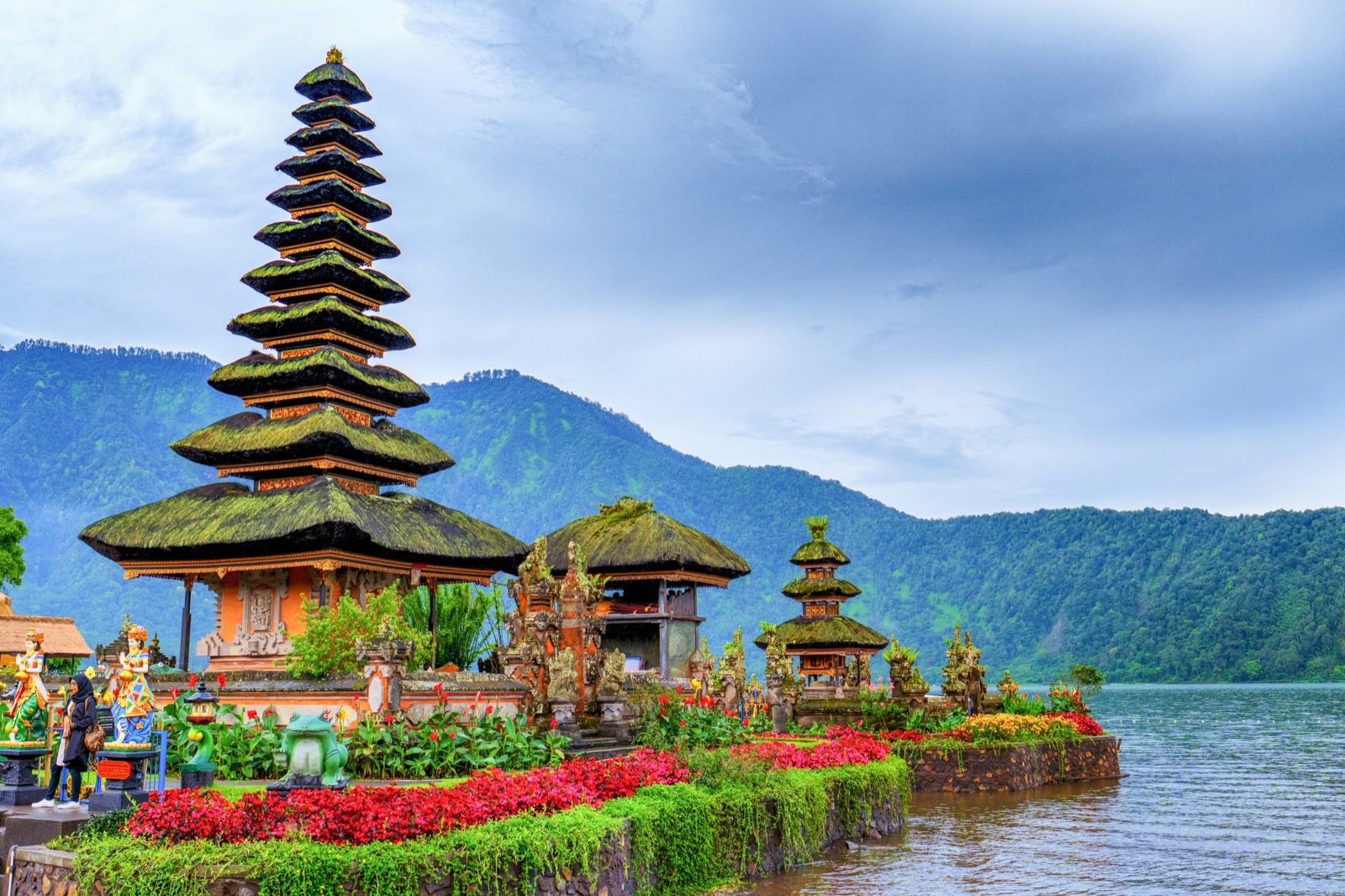
Bali's Subak Cultural Landscape was inscribed as a UNESCO World Heritage Site in 2012 — not for any single temple or terrace, but for the integrated system of water temples, irrigation channels, rice paddies, and community governance that has managed Bali's highland water resources since the 9th century. The inscription covers five component areas across 19,500 hectares, including the Jatiluwih terraces in Tabanan Regency and Pura Ulun Danu Bratan — the water temple on Lake Bratan visible in the photo above, whose priests have historically coordinated irrigation schedules across the entire southern watershed. UNESCO's primary ongoing concern is agricultural land conversion within and around the inscribed boundaries, a concern in direct tension with Bali's development trajectory.
In December 2025, that tension became visible when farmers at Jatiluwih erected metal sheeting to block tourist sightlines in protest at government demolition orders on farm buildings within the Heritage zone — orders arising from spatial planning violations. The protest caused an 80% drop in visitors within days, and was resolved by negotiation within weeks. The episode demonstrated both the leverage that communities hold over tourism-dependent sites and the ongoing failure to resolve underlying land rights and spatial planning disputes within the World Heritage area.
Bali's Gubernatorial Regulation 97/2018 banned single-use plastic bags, straws, and polystyrene from 1 July 2019. The regulation survived a Supreme Court challenge the same year — a significant legal precedent. Enforcement remains uneven, particularly outside Denpasar and the main tourist corridors, but the regulatory framework is in place. A proposed further regulation to ban the production and sale of plastic water bottles under one litre — directly targeting tourist water consumption — was in regulatory development as of early 2026.
On 14 February 2024, Bali introduced a tourist levy of IDR 150,000 (approximately USD 10) per international visitor, payable via the Love Bali platform or at Ngurah Rai airport. The levy is distributed directly to Desa Adat — Bali's 1,493 customary villages — to fund cultural preservation and infrastructure. At current international visitor volumes, the levy generates meaningful revenue for village communities, though USD 10 per arrival remains modest relative to the documented costs of mass tourism on local water, land, and cultural resources.
At the national level, Indonesia's Ministry of Tourism and Creative Economy operates a Green Parekraf strategy that explicitly prioritises sustainable destination certification and seeks to disperse visitors away from Bali toward secondary destinations including Labuan Bajo, Lake Toba, and Lombok. The dispersal goal has been a stated policy objective for over a decade; progress has been slow in practice, as infrastructure investment and operator networks remain concentrated in Bali. For responsible operators, the policy direction provides a useful signal: Indonesia wants to develop alternatives to Bali-centric itineraries, and tour programmes that include secondary destinations align with that national interest.